

2.4.2026
Why More Teams Are Switching from LinkedHelper to Snaily.io
LinkedIn automation has become a core part of B2B sales and lead generation. For founders, consultants, agencies, and sales teams, manual outreach is no longer enough to build predictable pipelines. As a result, more professionals are turning to automation platforms to scale their LinkedIn activity in a structured and compliant way.
For many years, LinkedHelper has been one of the most recognizable names in this space. It offers a wide range of features and positions itself as both an automation and CRM system. However, as outbound sales and growth strategies evolve, users increasingly look for tools that are more flexible, secure, and future-ready.
This is where Snaily.io comes in.
Snaily represents a new generation of LinkedIn automation software. It was built not as a complex all-in-one system, but as a focused, scalable platform that fits naturally into modern sales and marketing workflows.
A More Flexible Way to Run LinkedIn Automation
One of the main differences between Snaily and LinkedHelper is how automation is deployed.
LinkedHelper works exclusively as a desktop application. This means your campaigns depend entirely on your local device. If your computer is turned off, disconnected from the internet, or overloaded, your automation stops. For individual users this may be acceptable, but for teams and agencies it quickly becomes a limitation.
Snaily follows a different approach. It offers a hybrid infrastructure that allows users to choose how they want to work. Those who are just starting with LinkedIn automation can run campaigns directly on their laptop using the Basic plan. This is ideal for freelancers, founders, and solo consultants who want a simple setup.
As outreach grows, users can switch to cloud automation with Pro and Teams plans. In this mode, campaigns run online, twenty-four hours a day, without depending on personal devices. This makes scaling much easier and removes technical bottlenecks.
Instead of forcing users into one model, Snaily adapts to different stages of business growth.
Built-In Security with Unified IP Technology
Account safety remains one of the biggest concerns in LinkedIn automation. Many users experience restrictions not because they automate too much, but because their activity looks inconsistent from a technical perspective.
Snaily addresses this problem through its Chrome companion application, which works as a secure proxy. When automation runs in the cloud and when the user logs into LinkedIn manually, both actions share the same IP address and session footprint.

From LinkedIn’s perspective, everything looks natural. Manual browsing and automated activity come from the same environment. This significantly reduces detection risks and improves long-term account stability.
Traditional desktop tools, including LinkedHelper, do not offer this level of synchronization. As a result, users often have to rely on external proxies or manual configurations.
With Snaily, security is built into the system from the start.
Lead Generation First, Not Feature Overload
LinkedHelper positions itself as a multifunctional platform. It includes CRM elements, recruitment tools, data scraping features, and complex campaign builders. While this can be useful for some advanced users, it often creates unnecessary complexity.
Many professionals do not need dozens of modules. They need a reliable way to connect with prospects, start conversations, follow up consistently, and nurture leads.
Snaily was designed around this reality.
Its core focus is lead generation as part of a broader sales funnel. The platform concentrates on essential outreach actions such as sending connection requests, delivering personalized messages, managing follow-ups, visiting profiles, and engaging with content.
By avoiding unnecessary layers, Snaily remains fast, predictable, and easy to manage. Users spend less time configuring systems and more time building relationships.
A Simple Interface That Saves Time
One of the most common reasons people abandon automation tools is usability. Complex interfaces, confusing workflows, and long onboarding processes discourage consistent usage.
Snaily takes the opposite approach.
The platform is intentionally minimalistic. Most users can create and launch their first campaign in a few minutes without any training. The logic of the system is intuitive, and the learning curve is low.
This simplicity leads to faster adoption inside teams and higher productivity. Instead of depending on technical specialists, sales and marketing professionals can manage campaigns independently.
In practice, this often makes a bigger difference than having dozens of advanced features that are rarely used.
Why Simplicity Enables Faster Innovation
Snaily’s focused architecture is not a limitation. It is a strategic advantage.
Because the platform is not overloaded with legacy components, the development team can introduce new features quickly and respond to user feedback. Improvements are released on a monthly basis, and functionality expands in line with real market demand.
Users are not locked into outdated systems. The product evolves continuously.
In contrast, platforms built around large, rigid feature sets often struggle to modernize. LinkedHelper users frequently remain tied to existing structures that are difficult to redesign.
Snaily’s simplicity gives it the flexibility to grow.
AI Integration as the Next Stage of Automation
One of the most important elements of Snaily’s roadmap is artificial intelligence.
The platform is being developed with AI layers integrated directly into outreach workflows. This includes intelligent message generation, advanced personalization, lead prioritization, campaign optimization, and adaptive sequencing.
Instead of adding AI as a separate tool, Snaily embeds it into the core system.
Learn more about the recent Snaily.io massive features updates here: https://snaily.io/snaily-io-got-smarter-messaging-scheduling-smart-lead-tools/
This is possible because of its modern architecture. Legacy desktop platforms, including LinkedHelper, are not designed for this level of AI integration. Their technical structure makes such development extremely difficult.
As outbound sales becomes more data-driven and intelligent, this difference will become increasingly important.
Designed for Teams, Agencies, and Scalable Operations
Snaily is not only a tool for individuals. Its Pro and Teams plans are built for organizational use.
Companies can manage multiple LinkedIn accounts, coordinate campaigns, assign roles, control access levels, and centralize outreach activities. Cloud automation allows distributed teams to operate without technical limitations.
This makes Snaily especially attractive for lead generation agencies, SaaS sales teams, consulting firms, and growth departments.
LinkedHelper remains more oriented toward individual users and small-scale setups.
Continuous Development and a 14-Day Free Trial
Snaily is actively developed and improved every month. Users receive regular updates, performance optimizations, security enhancements, and new functionality.
At the same time, the platform offers a full-featured fourteen-day free trial. This allows users to test real campaigns, evaluate results, and compare performance without long-term commitments.
It is an opportunity to experience the system in practice before making a decision.
A Platform Built for the Future of LinkedIn Outreach
LinkedHelper remains a recognizable tool with a long history. For some users, its wide feature set may still be relevant.
However, modern lead generation requires more than automation scripts. It requires cloud infrastructure, advanced security, team scalability, AI readiness, and continuous innovation.
Snaily.io combines all of these elements in a focused, user-friendly platform. It is not designed to replace human sales efforts. It is designed to amplify them. For professionals who want predictable, scalable, and future-proof LinkedIn outreach, Snaily represents a smarter long-term choice.
Related articles
by Alfred
how to
6.8.2026
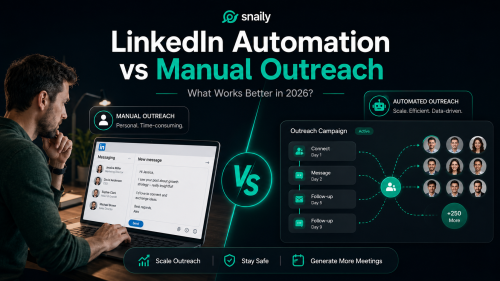
LinkedIn Automation vs Manual Outreach: What Works Better in 2026?
LinkedIn has evolved into one of the most effective platforms for B2B LinkedIn lead generation, enabling companies to expand their professional...
by Alfred
how to
3.23.2026
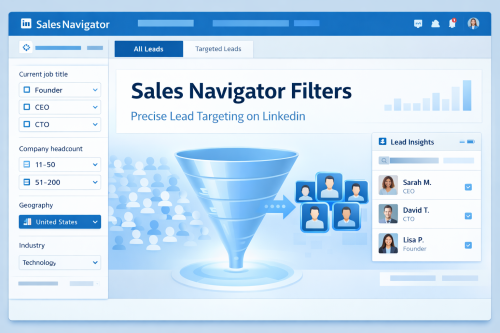
How to Use Sales Navigator Filters for Precise Lead Targeting
Introduction: Why Sales Navigator Still Matters In this article, we will explain why Sales Navigator remains one of the most powerful tools you...
by Alfred
how to
9.29.2025
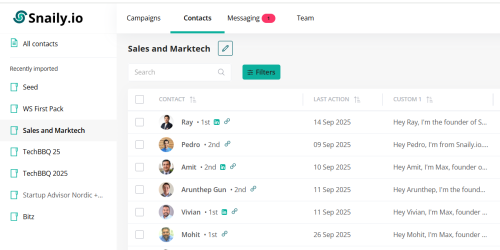
How to Personalize Every Message in Your Snaily Campaign
Why Personalization Matters? Generic outreach no longer works. On LinkedIn, every prospect must feel like your message was written just for them....

by Alfred
how to
3.27.2024
What is LinkedIn automation?
In today’s world, where every second counts, especially in the professional sphere, LinkedIn stands out as the go-to spot for anyone looking to up...
