
6.8.2026
LinkedIn Automation vs Manual Outreach: What Works Better in 2026?
LinkedIn has evolved into one of the most effective platforms for B2B LinkedIn lead generation, enabling companies to expand their professional networks, engage with decision-makers, and create new business opportunities. As the platform’s role in sales and marketing continues to grow, businesses are constantly searching for the most efficient ways to reach potential clients.
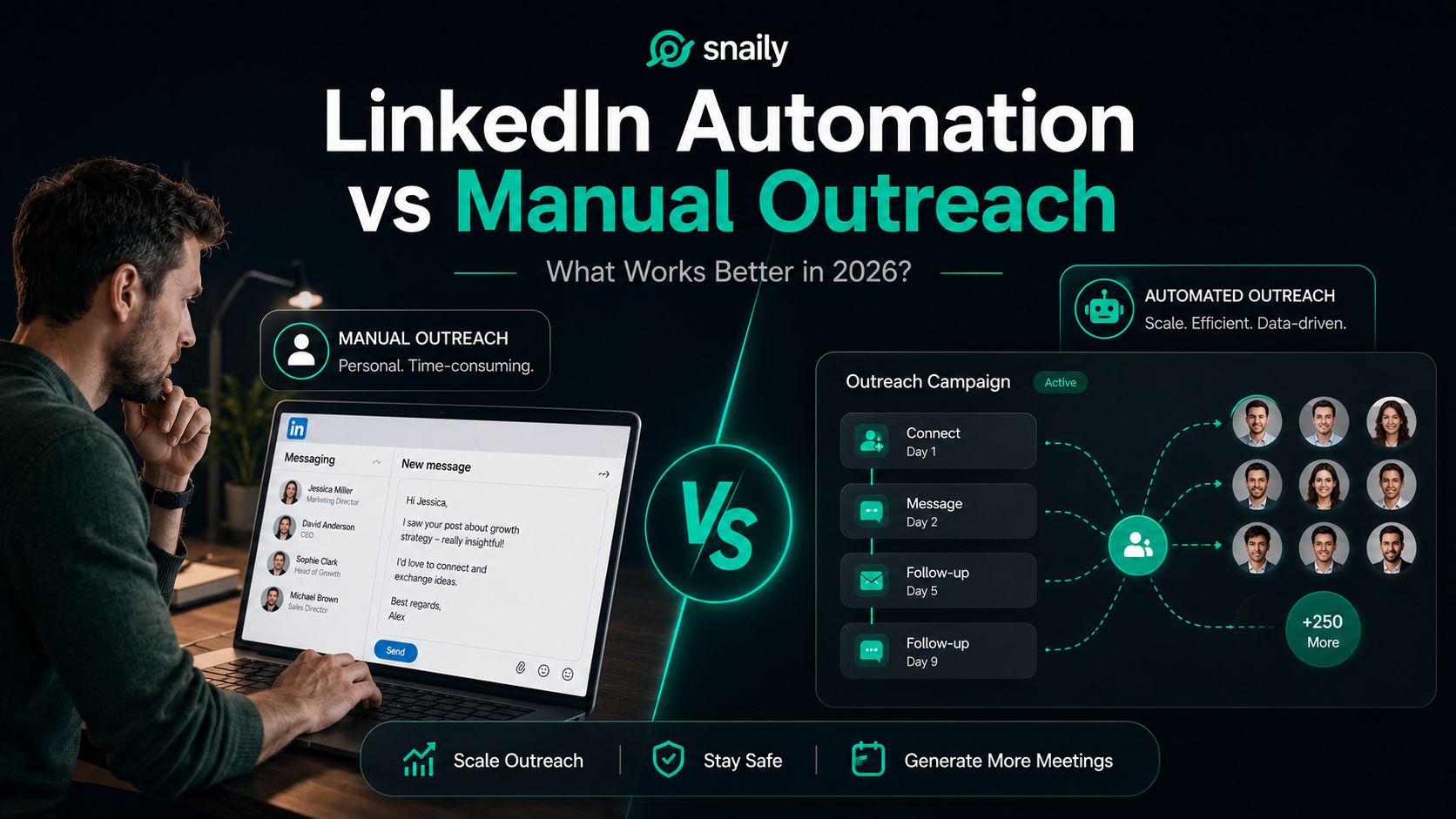
Today, LinkedIn outreach strategy is typically built around two main approaches: manual communication, which emphasizes personalized interactions, and automated outreach, which focuses on speed, scalability, and process optimization. Each method offers unique advantages and presents its own challenges, making the choice less straightforward than it may seem.
As sales teams, marketers, and business owners seek to maximize both efficiency and results, one question remains at the center of the discussion: which approach delivers greater value in today’s B2B environment?
What Is Manual LinkedIn Outreach?
Manual LinkedIn outreach is a hands-on approach to prospecting in which every stage of communication is managed directly by a sales representative or business development professional. This typically includes identifying relevant prospects, sending personalized connection requests, writing individual messages, and following up based on each recipient’s response or engagement.
Pros of Manual Outreach
One of the primary advantages of manual outreach is the ability to deliver highly personalized communication. Rather than relying on predefined templates, sales professionals can adapt their messaging to each prospect, making interactions more relevant and increasing the likelihood of engagement.
Manual outreach also provides complete control over the communication process. Representatives can monitor how prospects respond, identify which messages resonate most effectively, and adjust their approach in real time. This direct feedback loop helps organizations refine their messaging and gain a deeper understanding of their target audience.
Another important benefit is compliance and account safety. Since all actions are performed manually, the risk of violating LinkedIn’s usage policies is significantly lower than with aggressive automation tools. At the same time, genuine human interaction often contributes to stronger professional relationships and greater trust throughout the sales process.
Cons of Manual Outreach
Despite its advantages, manual outreach presents several operational challenges. The most significant limitation is scalability. Researching prospects, crafting personalized messages, and managing follow-ups individually requires substantial time and effort, making it difficult to maintain consistent outreach as lead volumes increase.
The approach is also heavily dependent on human performance. As outreach volumes grow, maintaining the same level of personalization and message quality becomes increasingly difficult. Inconsistent execution can lead to missed opportunities and lower overall efficiency.
Manual processes may also create organizational challenges, particularly within larger sales teams. Without centralized systems and clearly defined workflows, multiple representatives may contact the same prospect, resulting in duplicated efforts and a poor customer experience. In addition, manual data entry increases the likelihood of errors, outdated information, and inconsistencies in CRM records, which can negatively impact future sales and marketing activities.
For these reasons, while manual outreach remains highly effective for building relationships and engaging high-value prospects, it can become resource-intensive and difficult to scale as organizations seek to expand their lead generation efforts.
What Is LinkedIn Automation?
LinkedIn automation refers to the use of specialized software tools designed to streamline and scale outreach activities on the platform. Instead of manually sending each connection request or follow-up message, these systems allow sales teams to build structured workflows that execute outreach processes automatically.
In practice, this typically includes automated connection requests, scheduled message sequences, follow-ups, and systematic management of prospect lists. Commonly used tools in this category include platforms such as QuickLead.io, Waalaxy, Snaily.io and Dux-Soup, among others.
Businesses that are new to LinkedIn automation should first understand the different approaches, limitations, and best practices involved in scaling outreach effectively. Read more in our guide to LinkedIn automation: What is LinkedIn automation?
How LinkedIn Automation Tools Work
Automation tools generally fall into two main categories: cloud-based systems and browser-based extensions.
Cloud-based tools operate on external servers rather than directly within a user’s browser. This allows campaigns to run continuously, even when the computer is turned off. These systems also tend to offer more flexible scheduling options and are generally designed to simulate more natural activity patterns.
Browser extensions and desktop-based applications, on the other hand, run locally on the user’s device and interact directly with LinkedIn through the browser interface. While they are often easier to set up, they depend on the browser being active and may be more exposed to platform detection mechanisms, which can increase the risk of account limitations if used aggressively.
Beyond this technical distinction, automation platforms have evolved into broader sales enablement systems rather than simple messaging tools. Many now function as multi-purpose outreach environments that support the entire prospecting workflow.
Advantages of LinkedIn Automation
One of the primary advantages of LinkedIn automation is scalability. While manual outreach limits the number of prospects a team can engage with each day, automation makes it possible to manage outreach to hundreds or even thousands of contacts simultaneously. This allows businesses to expand their lead generation efforts without proportionally increasing workload.
Automation also delivers significant time savings by handling repetitive tasks such as connection requests, follow-up messages, and prospect management. As a result, sales professionals can dedicate more time to strategic activities, including lead qualification, relationship building, and closing deals.
Another important benefit is consistency. Automated workflows ensure that prospects receive timely follow-ups and that outreach processes are executed according to a predefined strategy. This reduces the risk of missed opportunities and creates a more predictable sales process.
These LinkedIn automation benefits make the approach particularly attractive for growing sales teams and agencies managing large prospect databases.
Moreover, modern automation platforms offer additional capabilities that enhance efficiency. Features such as personalized message variables, behavioral triggers, contact enrichment, CRM integration, and performance analytics help teams manage campaigns more effectively and optimize results based on real-time data. Many tools also support multichannel outreach by combining LinkedIn communication with email campaigns.
Limitations of LinkedIn Automation
Despite its benefits, LinkedIn automation is not without risks. One of the most significant concerns is account safety. Excessive activity or poorly configured automation can violate LinkedIn’s policies, potentially resulting in warnings, temporary restrictions, or account suspension.
How to make your profile ready for LinkedIn atumation? Read on our article about LinkedIn profiles warm-up strategies.
Automation can also reduce the quality of personalization if used incorrectly. Although modern tools provide customization options, automated messages may still appear generic or impersonal when campaigns are poorly segmented or rely too heavily on templates. This can negatively affect response rates and damage brand perception.
In addition, automated outreach remains dependent on platform limitations and tool capabilities. Activity thresholds, technical restrictions, and changes to LinkedIn’s policies can impact campaign performance and require continuous monitoring. For this reason, successful automation requires not only the right technology but also a thoughtful strategy and ongoing optimization.
Key Differences Between Automation and Manual Outreach
Both manual outreach and LinkedIn automation can be effective lead generation strategies, but they serve different purposes. Manual outreach prioritizes relationship building and personalized communication, while automation focuses on efficiency, scalability, and process optimization. Understanding the strengths and limitations of each approach can help businesses choose the right strategy based on their goals, resources, and target audience.
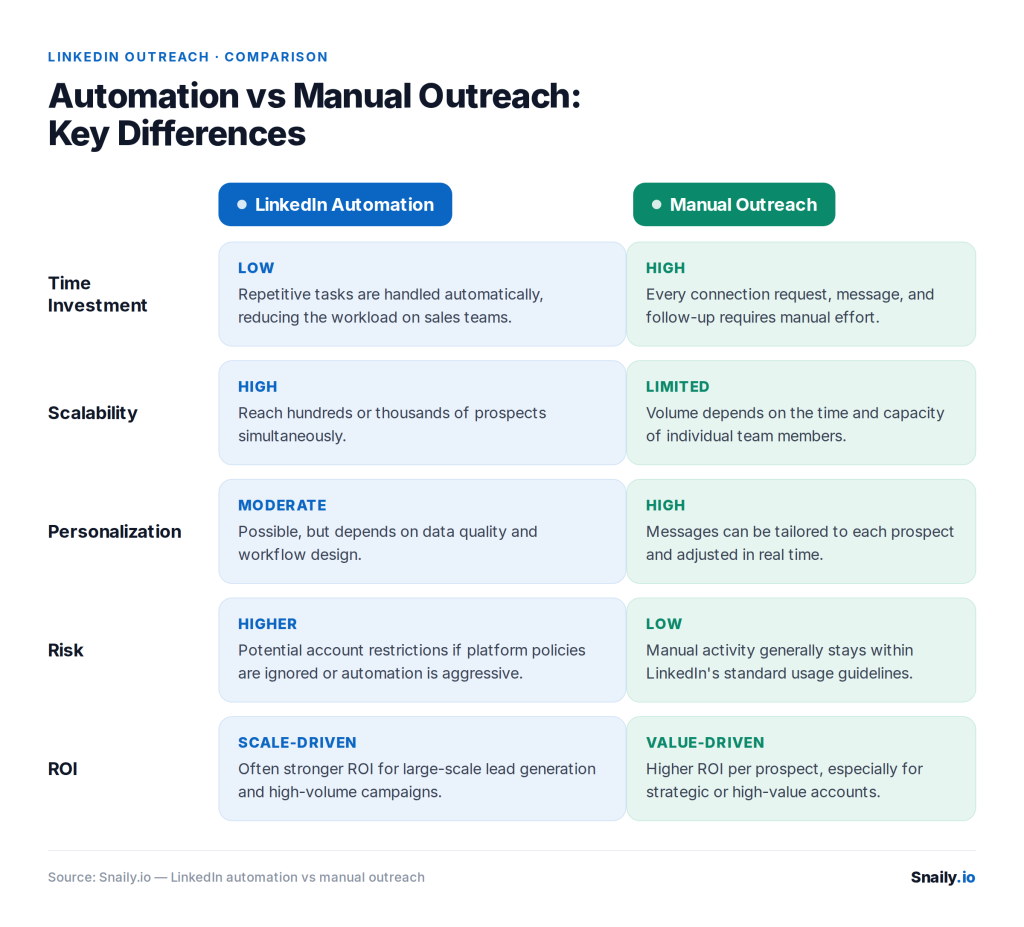
The comparison highlights that neither approach is universally superior. Automation offers efficiency and scale, while manual outreach excels at building trust and creating meaningful business relationships. For many organizations, the most effective strategy is not choosing one over the other, but combining both to balance personalization with growth.
Which Strategy Gets Better Results?
The effectiveness of LinkedIn outreach cannot be measured by a single metric. While reply rates, meeting rates, and conversions are all important indicators, the best-performing strategy often depends on the type of prospects being targeted and the goals of the campaign.
Industry research from HubSpot consistently shows that personalization remains a key factor in improving engagement and conversion outcomes throughout the sales process.
In many cases, manual outreach generates stronger engagement metrics. Personalized messages tend to attract more attention, encourage meaningful conversations, and build trust more effectively than generic communication. As a result, manual outreach often achieves higher reply rates and can lead to more qualified meetings, particularly when targeting decision-makers or high-value accounts.
Automation, on the other hand, excels in reach and efficiency. Although response rates may be lower on an individual basis, automation enables businesses to engage a much larger audience within the same timeframe. This increased volume can generate a substantial number of opportunities, making automation highly effective for top-of-funnel prospecting and large-scale lead generation.
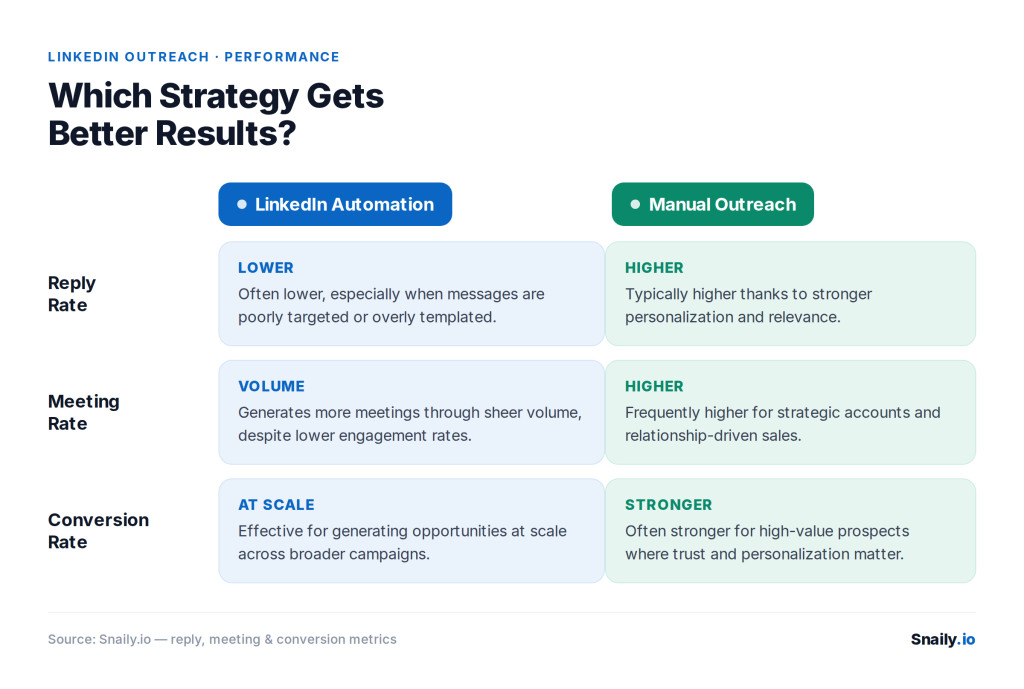
The ideal LinkedIn outreach conversion rate depends not only on the method used but also on audience quality, targeting accuracy, and message relevance.
Rather than viewing automation and manual outreach as competing approaches, many organizations use them at different stages of the sales process. Manual outreach is often most effective when building relationships with key prospects, while automation helps maintain consistent activity across larger target audiences.
For businesses that are just beginning to develop their LinkedIn outreach strategy, a manual-first approach can be particularly valuable. Direct interaction with prospects provides immediate feedback on messaging, audience preferences, and engagement patterns. These insights help teams understand what resonates before introducing automation into the process.
As outreach programs mature, automation can then be used to scale proven processes without sacrificing efficiency. The most successful teams typically follow a balanced approach: they use manual outreach to refine messaging and build relationships, then apply automation strategically to expand reach and support growth.
In simple terms, manual outreach delivers quality, while automation delivers scale. The strongest results are often achieved when approach to LinkedIn outreach businesses combine both approaches rather than relying exclusively on either one.
Is LinkedIn Automation Safe?
One of the most common questions businesses ask is: is LinkedIn automation safe? The answer largely depends on how the technology is used. Automation itself is not necessarily the problem—aggressive activity, unnatural behavior patterns, and poor account management are typically what create risks.
LinkedIn monitors user activity and is designed to identify behavior that differs significantly from normal human interaction. Sending large numbers of generic connection requests within a short period, for example, can raise red flags. By contrast, moderate outreach volumes, personalized messaging, and natural activity patterns are generally less likely to attract unwanted attention. Businesses can also review LinkedIn’s official guidance on account safety and platform policies through the LinkedIn Help Center, which is the strongest authority source for this topic.
Three factors play a particularly important role in account safety: activity limits, account warm-up, and overall account behavior.
Understanding LinkedIn’s activity restrictions is essential before launching any automated campaign. For a detailed breakdown, see our guide to LinkedIn limits: LinkedIn Outreach Without Getting Blocked in 2026
Respecting Activity Limits
Safe automation strategies are built around reasonable daily activity levels. Rather than maximizing the number of connection requests or messages sent, effective outreach focuses on maintaining consistent and sustainable engagement.
Most reputable automation platforms include safeguards such as daily activity caps, randomized delays between actions, and scheduling features that help mimic natural user behavior. These measures reduce the likelihood of triggering platform restrictions while still allowing teams to scale their outreach efforts.
The Importance of Account Warm-Up
New or inactive LinkedIn accounts require special attention before automation is introduced. A sudden increase in outreach activity from a profile with little recent engagement can appear suspicious.
A gradual warm-up period helps establish a healthy activity history. This may include connecting with existing contacts, engaging with content, participating in discussions, and building a record of normal platform usage before launching larger outreach campaigns. Taking this step can significantly reduce risk and improve long-term campaign performance.
Maintaining Natural Account Behavior
Successful automation should support human activity rather than replace it entirely. Profiles that combine outreach with regular engagement, content interaction, and meaningful conversations tend to appear more authentic than accounts focused solely on automated actions.
It is also important to prioritize quality over volume. Strong acceptance rates and relevant targeting signal genuine networking activity, whereas large numbers of ignored connection requests may indicate poor outreach practices.
Ultimately, LinkedIn automation is safest when it is used to enhance a well-managed outreach strategy rather than maximize activity at all costs. Businesses that respect platform limits, warm up accounts appropriately, and maintain natural engagement patterns can often benefit from automation while minimizing potential risks.
Best Strategy: Combine Automation and Personalization
For most businesses, the question is no longer whether to choose automation or manual outreach. The most effective LinkedIn strategies combine both approaches, using each where it creates the greatest value.
Automation is particularly useful during the early stages of prospecting. It allows sales teams to identify potential leads, send initial connection requests, manage follow-ups, and maintain consistent outreach across a large audience. This creates the scale needed to generate a steady flow of opportunities without overwhelming internal resources.
However, as prospects begin to engage, personalization becomes increasingly important. Once a lead shows interest, responds to a message, or enters a more advanced stage of the sales process, human interaction often delivers better results. Personalized conversations help build trust, address specific business needs, and move prospects toward meaningful outcomes such as meetings, partnerships, or sales.
Whether businesses rely on automation or manual communication, successful LinkedIn cold messaging requires relevant targeting, clear value propositions, and consistent follow-up.
That’s why, in practice, many organizations follow a simple model: automation supports the first contact, while manual outreach supports relationship development and conversion. This approach allows businesses to benefit from the efficiency of automation without sacrificing the authenticity that drives engagement and decision-making.
Rather than viewing automation and personalization as competing strategies, companies should treat them as complementary elements of a single outreach process. Automation provides the scale needed to reach new prospects, while human communication helps turn those prospects into valuable business relationships.
Tools for LinkedIn Outreach
A wide range of LinkedIn outreach tools is available to help businesses streamline LinkedIn outreach and manage prospecting activities more efficiently. These platforms are designed to automate repetitive tasks such as sending connection requests, scheduling follow-up messages, organizing prospect lists, and tracking campaign performance.
While features vary from one solution to another, most tools aim to reduce manual workload and improve the consistency of outreach efforts. Popular options on the market include Snaily, Dripify, and Expandi, which offer different approaches to campaign management, automation, and lead generation.
However, the effectiveness of any tool depends less on the software itself and more on how it is used. Even the most advanced platform cannot compensate for poor targeting, weak messaging, or a lack of personalization. For this reason, businesses should view automation tools as a way to support their outreach strategy rather than replace human interaction altogether.
Conclusion
There is no universally “best” approach to LinkedIn outreach. Both automation and manual communication play an important role, and their effectiveness depends on how they are combined rather than compared in isolation.
Automation brings efficiency, consistency, and scalability, making it suitable for reaching a larger pool of prospects and managing repetitive outreach tasks. Manual outreach, in turn, adds personalization, context, and authenticity, which are essential for building trust and converting high-value opportunities.
The most effective strategies are typically hybrid. In practice, this means treating automation as a way to open doors, while using human interaction to build and close relationships. When a prospect shows interest through an automated touchpoint, transitioning to a manual, personalized follow-up often leads to stronger engagement and better results.
Try automating your LinkedIn outreach while keeping personalization at the center of your strategy — tools like Snaily can help scale outreach safely and efficiently.
Ultimately, success on LinkedIn is not about choosing between automation and manual outreach, but about combining them strategically to balance efficiency with genuine connection.
FAQ
Is LinkedIn automation safe?
LinkedIn automation can be safe when used responsibly and within platform limits. The key is not the automation itself, but how it is applied. Think of it like driving a car: careful and controlled use is generally safe, while aggressive or careless behavior increases risk.
In most cases, LinkedIn first issues warnings when unusual activity is detected, allowing users to pause campaigns and adjust their behavior. Serious penalties, such as permanent restrictions, are rare and typically associated with high-risk practices such as using multiple tools at once, bypassing platform limits, or relying on low-quality software that does not mimic human behavior.
Ultimately, tool quality and usage strategy matter more than the decision to automate itself.
Does manual outreach work better?
Manual outreach is often more effective when the goal is to build strong relationships and engage high-value prospects. It allows for fully personalized communication, where tone, timing, and messaging can be adapted to each individual.
This approach is particularly valuable for decision-makers, long-term partnerships, and conversations that require trust and context. While it requires more time and effort, it often leads to deeper engagement and higher-quality connections.
What is the best outreach strategy?
There is no single best approach. The most effective strategy is usually a combination of both methods: automation for scalable, repetitive tasks and manual outreach for meaningful, high-value interactions. This balance allows businesses to stay active while maintaining personalization where it matters most.
Can you combine automation and manual outreach?
Yes, and in most cases, this is the most effective approach. Automation helps maintain consistent activity and reach a larger audience, while manual outreach ensures personal engagement with the most important prospects.
This hybrid model also improves time management. Routine tasks can be automated, while manual effort is focused on conversations, relationship-building, and high-priority opportunities. As a result, businesses achieve both efficiency and authenticity in their outreach strategy.
Related articles
by Alfred
how to
3.23.2026
How to Use Sales Navigator Filters for Precise Lead Targeting
Introduction: Why Sales Navigator Still Matters In this article, we will explain why Sales Navigator remains one of the most powerful tools you...
by Alfred
how to
2.4.2026
Why More Teams Are Switching from LinkedHelper to Snaily.io
LinkedIn automation has become a core part of B2B sales and lead generation. For founders, consultants, agencies, and sales teams, manual outreach...
by Alfred
how to
9.29.2025
How to Personalize Every Message in Your Snaily Campaign
Why Personalization Matters? Generic outreach no longer works. On LinkedIn, every prospect must feel like your message was written just for them....

by Alfred
how to
3.27.2024
What is LinkedIn automation?
In today’s world, where every second counts, especially in the professional sphere, LinkedIn stands out as the go-to spot for anyone looking to up...
